

Mistral Large 4 is a frontier-scale AI model that comes from neither the US nor China, and that is rare. Nearly every model this big in 2026 is made by an American or Chinese lab. Mistral, from France, released it as a public preview on 6 October 2026: 1 trillion parameters, open weights promised for late October, and a price of $1.36 per million input tokens and $4.18 per million output tokens. That is slightly cheaper than GLM-5.3 and far cheaper than Kimi K3 or Claude Opus 5. In a blind code-quality test that Mistral published, it narrowly beat GLM-5.3 and Kimi K3, but Claude Opus 5 was still clearly ahead. If your organisation needs a strong model that is not tied to the US or China, this is now the main option. If you just want the best code, Claude is still in front.
This makes three trillion-scale open-weight releases in three months: Kimi K3 in July and GLM-5.3 in August, both from China, and now Mistral Large 4 from Europe. In August I wrote about why you shouldn't lock into an annual AI subscription, and this release is one more reason. Below I put Mistral Large 4 next to the three models people are most likely to compare it with, using each maker's own published numbers.
What Is Mistral Large 4?
It is Mistral's new flagship, nicknamed "le Chonk". It is a mixture-of-experts model: it has 1 trillion parameters in total, but only 52 billion are used for each token. That is how a model this big can still be cheap to run per request. It can take images as well as text, and it can answer quickly or switch into a slower reasoning mode.
- Released: 6 October 2026 as a public preview on Mistral Studio (console.mistral.ai).
- Open weights: promised "by the end of the month", so late October 2026. Mistral has not said which licence they will use yet.
- Training: trained from scratch on 3,800 NVIDIA Grace Blackwell GPUs in Mistral's own European datacentres.
- Languages: training data in more than 160 languages, including every official EU language.
- Deployment: several regions, including a European deployment that Mistral runs end to end, plus private cloud or on-premises for sensitive work.
Mistral has not published the context window in the announcement. It says more details on the architecture and training will come with the open weights.
Why Does It Matter That Mistral Is Not From the US or China?
Look at who makes the biggest AI models in 2026. The closed frontier models, such as Claude, GPT and Gemini, come from US companies. The biggest open-weight models, such as Kimi, GLM, DeepSeek and Qwen, come from Chinese labs. Very few companies anywhere else have trained a model at this scale, and Mistral is the best-known of them. Mistral says Large 4 leads open-weight models developed outside China "by a wide margin" on cybersecurity tests.

For many organisations, where a model comes from matters as much as how good it is. A bank, a hospital or a government department may not be allowed to send data to a Chinese provider. It may also not want to depend on a US company that could change its prices, terms or availability overnight. Until now, those organisations had to accept a weaker model or pick one of the two sides. Mistral's pitch is a third option: "Forged in Europe. Built for AI sovereignty."
Mistral backs this up with its own infrastructure. It trained the model from scratch on its own GPUs in European datacentres, serves the preview from the same place, and offers a European deployment that it runs end to end. Once the weights are released, organisations can also run it on their own servers and avoid any outside provider at all. For Australian developers like me, who mostly use American or Chinese models today, more choice is good news too.
How Does It Compare With Kimi K3, GLM-5.3 and Claude Opus 5?
On size, Mistral Large 4 sits in the middle of the open models. Kimi K3 is almost three times bigger, and GLM-5.3 is a little smaller. Anthropic does not publish the size of Claude Opus 5.

| Model | Maker | Released | Total / active parameters | Weights |
|---|---|---|---|---|
| Mistral Large 4 | Mistral AI (France) | 6 Oct 2026 (preview) | 1T / 52B | Promised for late October |
| GLM-5.3 | Z.ai (China) | Aug 2026 | 744B / 40B | Open, custom licence |
| Kimi K3 | Moonshot AI (China) | Jul 2026 | 2.8T / 104B | Open, custom licence |
| Claude Opus 5 | Anthropic (US) | 24 Jul 2026 | Not published | Closed, API only |
The only test that puts all four side by side is a blind human review of code quality, run by Surge AI and published on Mistral's launch page. Reviewers rated code from each model on a 1 to 5 scale without knowing which model wrote it.
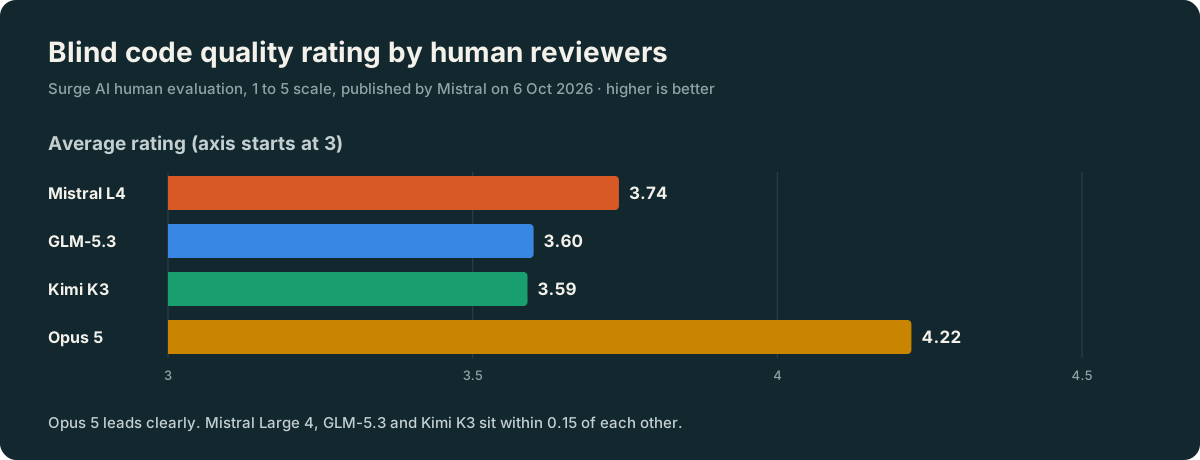
Claude Opus 5 scored 4.22. Mistral Large 4 came second with 3.74, just ahead of GLM-5.3 (3.60) and Kimi K3 (3.59). Keep in mind that Mistral picked this test and published it. The gap between the three open models is small, while the gap to Opus 5 is large.
Mistral and Z.ai both report two of the same agent tests, although each company ran its own:
- DeepSWE v1.1 (fixing real software bugs): GLM-5.3 66.9%, Mistral Large 4 61.7%.
- AutomationBench (business automation tasks): Mistral Large 4 59.9%, GLM-5.3 48.2%. Mistral also says it beats Kimi K3 here, but it gives no number for K3.
So GLM-5.3 is still better at fixing bugs, and Mistral Large 4 is better at automation work. Neither is a clear winner overall.
Is Mistral Large 4 Cheaper?
Yes, but only by a little compared with GLM-5.3. Compared with Kimi K3 and Claude Opus 5, the difference is large.
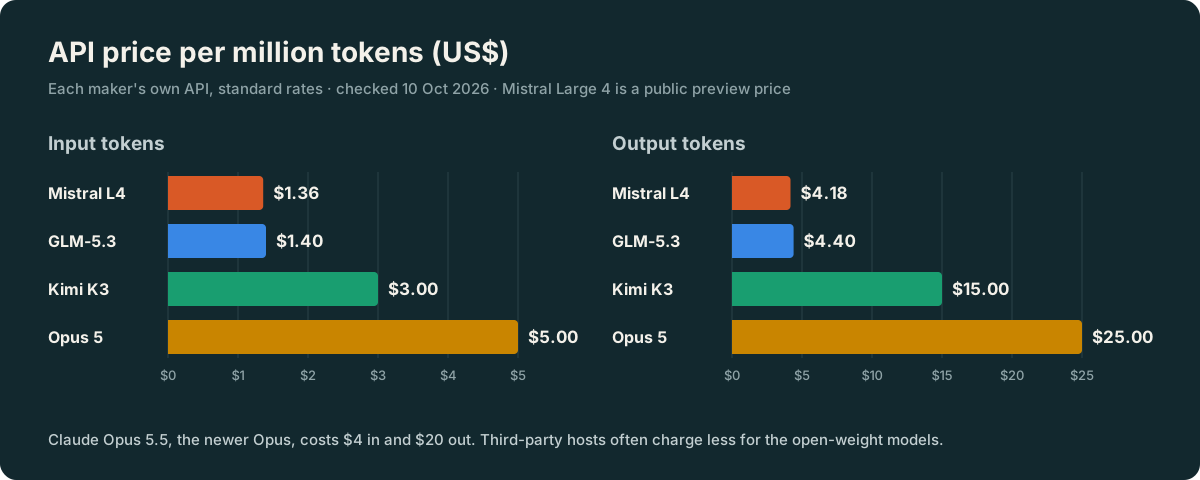
| Price per 1M tokens (US$) | Mistral Large 4 | GLM-5.3 | Kimi K3 | Claude Opus 5 |
|---|---|---|---|---|
| Input | $1.36 | $1.40 | $3 | $5 |
| Output | $4.18 | $4.40 | $15 | $25 |
| Cost of the example job below | $8.89 | $9.20 | $22.50 | $37.50 |
To make the prices concrete, I used the same example as in my Claude family comparison: summarising 1,000 documents, with 5,000 tokens in and 500 tokens out for each one.
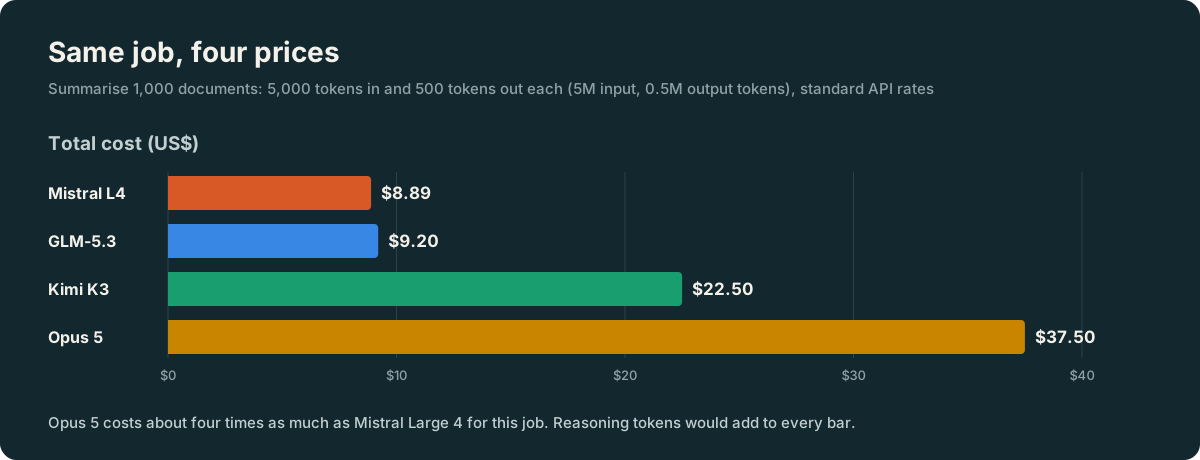
Two things to note. First, these are the makers' own API prices. Third-party hosts on OpenRouter often charge less for the open models. Second, Claude Opus 5 is no longer Anthropic's newest Opus. Opus 5.5 replaced it in September at $4 in and $20 out, which would make the same job cost $30.
What About Cybersecurity and Safety?
This is the part of the announcement I found most surprising. Mistral says Large 4 is one of the top five models in the world on the Artificial Analysis Cyber Index, and well ahead of every other open model built outside China.

- It scored 93% on Cybench and 82% on a test where the model must reproduce a software vulnerability and then patch it.
- Mistral says Claude Opus 5.5 and GPT-6 Astra score close to zero on that 82% test, because they refuse to do it.
- On the Lakera B3 agent security test, which measures how well a model resists attacks, it scored 93.3%.
This cuts both ways. A model that will reproduce vulnerabilities is useful for security teams, and it is also useful for attackers. Anthropic's models refuse these tasks on purpose. Which behaviour you want depends on who you are, and once the weights are public, anyone can use it.
Can I Run Mistral Large 4 at Home?
No, not on a normal PC. I run local models on an RTX 4060 Ti with 8 GB of video memory, and a 1 trillion parameter model is far beyond that. Even squeezed down to 4 bits, the weights alone would need roughly 500 GB of memory. For comparison, GLM-5.3, which is smaller, officially needs a server with eight 141 GB GPUs.
The open weights matter for companies with their own GPU servers, and for hosting providers who will offer it more cheaply. For the rest of us, it is an API model. If you want something that really runs on a home graphics card, see my guide to local LLMs versus cloud APIs.
Which One Should You Use?
- Best code quality, price not a problem: Claude (Opus 5.5 rather than Opus 5 today).
- A strong model that is not from the US or China, or with data kept in Europe: Mistral Large 4. It is also the cheapest of the four.
- Fixing bugs in an existing codebase on a budget: GLM-5.3 still has the better DeepSWE score.
- Front-end and website work: Kimi K3 is still the one I use. It topped the Frontend Code Arena, and it is what I switched to in August.
My plan is to try Mistral Large 4 on my own website builds when the preview has settled, and compare it with Kimi K3 on the same tasks. Benchmarks published by the company that made the model are a starting point, not the answer.
Related reading: Claude models compared: Haiku, Sonnet, Opus, Fable · Why you should avoid annual AI subscriptions in 2026 · Local LLM vs cloud API in 2026
Sources
- Mistral AI, "Mistral Large 4", mistral.ai/news/mistral-large-4 (6 October 2026): size, price, training, languages, all Mistral Large 4 scores, the Surge AI code-quality ratings and the cyber and safety claims.
- Z.ai GLM-5.3 specifications and vLLM recipe, summarised by Kingy AI; price cross-checked on Artificial Analysis: GLM-5.3 size, price, DeepSWE and AutomationBench scores, hardware.
- Kimi K3 size, licence and price: OpenRouter and Hashnode, using Moonshot's official $3/$15 rate.
- Anthropic, "Pricing", platform.claude.com/docs/en/about-claude/pricing: Claude Opus 5 and Opus 5.5 prices.
Figures checked on 10 October 2026. Mistral Large 4 is a public preview, so its price and details may change before the open weights are released. The DeepSWE and AutomationBench scores come from two different companies' own tests and may not have used identical settings. The cost example is my own arithmetic at standard rates and leaves out reasoning tokens. This article was researched and drafted with AI assistance and reviewed by me. The images were made locally with Qwen Image 2.1 on an 8 GB RTX 4060 Ti, and the charts were drawn from the published numbers.