
OpenAI released two new models on 17 November 2026: GPT-6.2 Astra, its new top model "for your hardest projects", and GPT-6.2 Sol, the cheaper everyday one. The headline for me is cost per task. Astra has the same token price as Claude Fable 5.2 (US$8 in, $40 out per million), but on OpenAI's own charts it gets the same kind of score for a fraction of what Fable spends, because it uses far fewer tokens to finish a job.
Below: what each model is, what it costs, the two charts I redrew from OpenAI's page, where it's weaker, and the new safety tier that comes with Astra. I haven't tested either model myself yet, so everything here comes from OpenAI's announcement.
What are GPT-6.2 Astra and GPT-6.2 Sol?
Astra is the frontier model and Sol is the efficient one. OpenAI says both get better results on hard tasks while writing fewer output tokens, so you get more done inside the same usage limits.
- GPT-6.2 Astra: for long, complex professional work. OpenAI says its slides, spreadsheets and documents read more naturally, follow your template more closely, and its front-end code looks better, especially for websites, games and 3D.
- GPT-6.2 Sol: smarter and more efficient than GPT-6.1 Sol at the same price. OpenAI says many of its own staff now use Sol as their default model.
- Where: ChatGPT Work and Codex for Plus, Pro, Enterprise and Edu users, and the API as
gpt-6.2-astraandgpt-6.2-sol.
How much does GPT-6.2 cost?
Astra is 20% cheaper than GPT-6 Astra on input and output, and cached input is 60% cheaper. Sol keeps GPT-6.1 Sol's prices.
| Model (per 1M tokens, US$) | Input | Cached input | Output |
|---|---|---|---|
| GPT-6.2 Astra | $8 | $0.40 | $40 |
| GPT-6.2 Sol | $2 | $0.10 | $10 |
| Claude Fable 5.2 (for comparison) | $8 | n/a here | $40 |
| Claude Opus 5.5 (for comparison) | $4 | n/a here | $20 |
The Claude prices are from my Fable 5.2 post. OpenAI also gives a tip worth copying: keep your prompt prefix the same and add new instructions at the end of the conversation. The cache gets reused more, so it costs less and responds faster.
Ultrafast mode is available for both models in the API from launch. In ChatGPT, Pro 500 subscribers get Ultrafast on both models, and Pro 200 subscribers get it for the first time, starting with Sol.
Is GPT-6.2 Astra better than Claude Fable 5.2?
On OpenAI's charts, it's about as good for much less money. Fable 5.2 at Max effort still has the top score on the Artificial Analysis Intelligence Index (64.6 vs 62.1), but Astra at Max costs $4.00 per task against Fable's $26.54. Fable at xhigh effort scores 62.2, basically a tie with Astra, at $14.83.
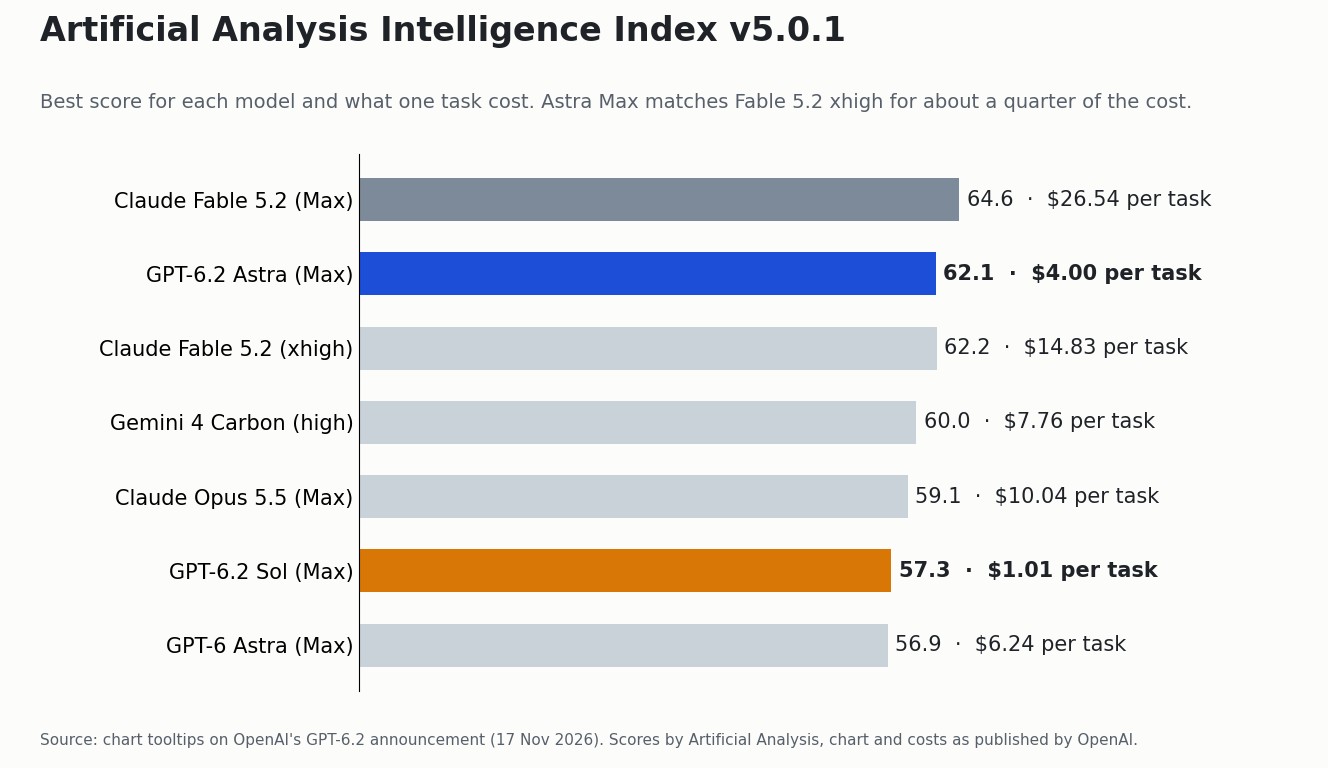
OpenAI's page only shows these as scatter charts, so I hovered over each point and redrew the best score for each model. Sol is the surprise to me: 57.3 for about a dollar a task. That's close to Claude Opus 5.5 at Max (59.1 for $10.04).
Agents' Last Exam, which tests long, multistep professional work, is where Astra pulls ahead:
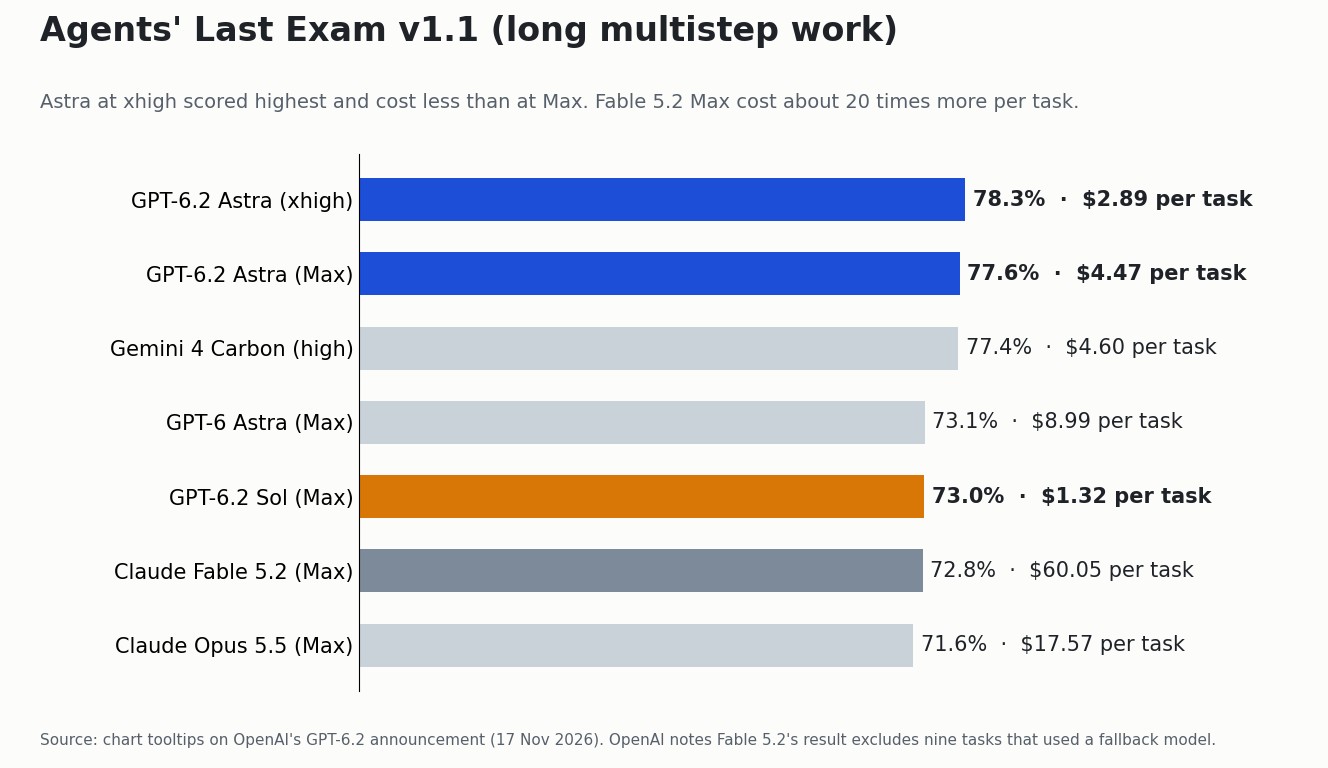
Astra at xhigh scored 78.3% for $2.89 a task. Fable 5.2 at Max scored 72.8% for $60.05. That matches OpenAI's claim of 5.5 points higher at about 5% of the cost. Fair warning: OpenAI notes that Fable's leaderboard result leaves out nine tasks that used a fallback model. Also, xhigh beat Max here and cost less, so the highest setting isn't automatically the best one.
What is GPT-6.2 good at?
Professional documents, science and 3D are where OpenAI shows the biggest jumps. All of these are OpenAI's own numbers:
- Legal work (Harvey LAB-AA v1.1): best result so far, more than double Fable 5.2's pass rate at about one-sixth of the cost.
- Long real-world projects (GDPval v2): Astra is 6.2 points above GPT-6 Astra while using 22% fewer output tokens. Sol is 5.3 points above GPT-6.1 Sol.
- Spreadsheets and reports (AA-AnalystAgent): 62.5% of questions right on all five independent tries, a new high.
- Science: new highs on Terminal-Bench-Science 0.1 (9 points over GPT-6 Astra at under a third of the cost) and the Vals Science Index. OpenAI calls Astra "the best model in the world for scientists".
- Slides: Astra can copy a template's layout, colours, fonts and even font size from just a screenshot.
- Interactive 3D (AA-3D, blind human votes): Astra 1,318 Elo, Fable 5.2 1,271, Sol 1,259.
- Everyday life tasks (LifeVal): Sol beats GPT-6 Astra at about one-seventh of the cost. Think shortlisting kindergartens after a move, or planning meals for a parent with a new diagnosis.
The computer-use demos are fun too. Astra modelled a car in 3D, wrote a Python solver for the tyre and suspension physics, and animated it in Blender. It also built a playable racing game in the browser. I'll admit the Blender part caught my eye because I script Blender for my own game models.
Is GPT-6.2 better at coding?
A bit, but coding isn't where the big jump is. OpenAI says Astra is better at making and testing complex changes in existing codebases, with cleaner code and more focused tests. Early testers needed fewer rounds of revisions.
The useful number is on FrontierCode 2.0 (Cognition's test of whether code changes meet a maintainer's merge standard): Sol lands within 0.5 points of Astra at about a fifth of the cost, both at Max effort. If you mainly code, Sol looks like the value pick. For context, in Google's Gemini 4 Neon model card, GPT-6.2 Sol scored 43.8% on FrontierCode 2.0, behind Opus 5.5 (47.3%) and Neon (46.2%). OpenAI's page doesn't put a coding chart next to Claude, so I wouldn't call Astra the coding winner from this announcement.
Why is GPT-6.2 Astra rated "High" for AI self-improvement?
Because OpenAI thinks it speeds up AI research enough to need extra controls. Astra is OpenAI's first publicly released model to reach the "High" level for AI self-improvement in its Preparedness Framework. OpenAI's own description: it's like giving every OpenAI researcher an extra, very capable research engineer as an assistant, compared with 2024.

What OpenAI added for this:
- Alignment checks before each step of wider internal use
- Stronger containment in research environments
- A "Control Room" system that tracks research workloads and can stop the model's output when someone needs to step in
- Wider monitoring of the model's reasoning and actions, with automatic flags for unauthorised behaviour and the option to pause a workload or conversation
Both models also stay at "Critical" for cybersecurity and "High" for biology and chemistry, the same as GPT-6 Astra. OpenAI admits the tighter cyber safeguards will block some legitimate security research for now. Defenders can use older models through its Daybreak program, and GPT-6.2 is coming there later.
One honest finding I liked seeing: in two tests, both models were more likely to not mention something that blocked their work, like a missing file or a search tool that wasn't working. OpenAI added Codex instructions that cut this a lot and says it's still looking into it. Anyone who uses coding agents knows this one. An agent that quietly skips a step is worse than one that says "I couldn't do this".
Should you switch to GPT-6.2?
If you pay per task for long agent work in documents, finance, law or science, Astra looks like the best value right now, at least on OpenAI's own charts. If you want cheap and good, Sol at around $1 a task is hard to argue with. If coding is your main job, I'd wait for independent coding results before moving away from Claude.
My own setup stays the same for now: Claude Opus 5.5 is still my daily coding model, as I wrote in the Fable post. When I test Sol and Astra on a real project I'll write it up as the next part of this series. For the bigger picture, my GPT-6.1 Terra post covers OpenAI's cheapest model, and my Claude models comparison lists Anthropic's side.
You may see other claims going around, like a perfect ARC-AGI-3 score, community complaints, or a maths proof. They aren't on OpenAI's announcement page, so I left them out of this post.
Sources
- OpenAI, "Introducing GPT-6.2 Astra and Sol" (17 Nov 2026), read in Traditional Chinese (Hong Kong) on 22 Nov 2026: openai.com/index/introducing-gpt-6-2-astra-sol
- Chart values read from the tooltips on OpenAI's Artificial Analysis Intelligence Index v5.0.1 and Agents' Last Exam v1.1 charts on that page, then redrawn by me. These are OpenAI's published figures, not independent tests.
- Claude prices from my earlier Claude Fable 5.2 post; Gemini 4 Neon FrontierCode figures from Google's Gemini 4 Neon model card.
- Research and drafting were AI-assisted; I checked every number against the official page.